
Best practice content writing
By using this best practice content writing guide anyone can profit from a faster rate of output, better quality and higher readership.
In a world of instant connectivity, where everyone is in essence a publisher, the quality of your content often comes across as the single most important impression that readers have of you or your business.
Best practice content writing is all about speeding up the process of creating content (while making sure all competencies in a writing team are used) and heightening the quality of your content are not mutually exclusive. All it takes is good planning, a bit of structure – and this guide for best practice content writing. Having fun doesn’t hurt either.
This best practice content writing guide is divided into seven parts:
- Why are you writing – gather facts and define key points and goals. Don’t try to re-invent the wheel.
- Who are you writing for – structure your tone and text for your audience. Set an appropriate reading level and cater for skimmers.
- Get the look right, make the structure clear – make your text look appealing and help the reader navigate. Avoid bullet-land.
- Use simple, grammatical sentences – keep sentences simple and as short as possible. Avoid strings of qualifying clauses.
- Use the right words – keep the reader in mind and use one word rather than several. Build a list of words to add to consistency over time.
- Be consistent in meaning and words used – adopt or create a style guide. Always refer to things in the same way, and stick to your decisions.
- Revise and edit your content – give yourself time and space to revisit your writing with a fresh pair of eyes. Pass your work over to a colleague, or a service such as Wordy.com.
At the end we provide a model workflow for writing and producing content, which you can adapt to your situation.
Why are you writing?
You must have a clear idea of what you want to say if you are to communicate it efficiently. You must have the content (the facts) to hand and you must also know what effect you want to have: do you want to inform, sell, persuade, alarm, reassure – or what?
Key points
Planning is key to a good end product. You must clarify meaning, message and then how you are going to structure your writing up front.
- What content do I want to get over? Gather all your facts and do your research up front. As you go along you may discover that you need to source other information, but do as much as you can first.
- What message do I want to get over? Are you trying to persuade, inform, entertain or do something else? Have in mind the effect you want to have on the reader: what do you want them to do or feel or think once they have read your document?
Structure
You next have to get your structure right. You could plan this as a series of headings or sections. Some people find it easier to work with mind maps to impose order on their ideas. Web designers and writers will use a series of cards with topics on and sort them on their desk to produce a wireframe.
If you are telling a story or relating history put events in a clear chronological order; flashbacks work OK in film but not in informative writing. If you are arguing a point or trying to persuade the reader, stick to essentials. Again, you must make your points in a logical order.
Certain types of writing: business letters, academic theses, minutes of meetings and so on have their own conventions and structure. Follow these and don’t try to re-invent the wheel. If you are unsure about structure try to get hold of a previous report, minutes or whatever to see how the document should be structured, or find out from a colleague or the internet.
Put important ideas and facts at the beginning of your document. In some cases an executive summary will ensure that key points are read even if the rest of your document is ignored.
Think about what you can leave out or put in an appendix at the end. You don’t want to clutter your writing unnecessarily.
Who are you writing for?
You have to know who your target audience is and who is likely to read your document. Only then can you make decisions about matters such as what tone to use, how complex or simple your writing and structure can be and how much technical language or jargon will be understood.
Key points
- Who are you writing for? Have you a specific target audience or is your document intended for a general readership?
- How will the reader read this? Will they skim read and come back to it if they need to absorb it, or are they likely to read in a concentrated fashion?
Your audience
It is vital to know whom you are writing for. If you are producing public information you must use plain English geared to a low reading age. There are various websites that will check a document for readability, and Word has this function as well. Business, academic, journalistic and technical writing can be geared to a higher reading level.
If you have to hold and keep your reader’s attention you must work at making all parts of the text lively and engaging. Even when you think you have a captive audience you should ensure your writing is a pleasure to read and not a chore.
Are you writing for native speakers of English? If you are a non-native English speaker you must be doubly sure you get it right. Keep to simple and reliable forms of grammar and words, use a service such as Wordy to check this out for you, or give it to a native speaker to review. If you are writing for non-native speakers, again you must be sure that grammar and the words used are absolutely correct.
How are they reading?
If you are producing web copy, advertising copy or a press release a reader may simply skim the document. In this case you must pay particular attention to the look of the document, to headings and to getting important words first in your sentences.
On the web, readers skim in an F-shaped pattern, i.e. they run their eye down the left-hand side of the text, only reading the occasional full line that grabs their attention. However, once persuaded that the page has information of value to them they will return and read it more thoroughly.
Use the right language
Do the readers understand specialist language or jargon? Think about whether you can get your message over using the comfort of terms you understand and acronyms that are second nature to you. Do you need to make sure that this is a text that could be understood by anybody? In other words, if there is a difference, use the reader’s language, not your own.
Get the look right, make the structure clear
Your writing must look interesting on the page as well as being interesting to read. You may use a designer to ensure a professional look, especially for a website or marketing brochure. However, you must still pay attention to paragraph length, headings, and other features on the page.
Key points
- Use headings to orient the reader
- Make sure your text looks appealing
Headings – short, long, informative, whimsical?
You know what your message and content, your structure and your audience are, so help your readers find their way round your document by making sure the structure is clear. Short informative headings that follow the logical progression of the document are key here. If necessary, use a hierarchy of headings and subheadings to add details to the structure.
If a reader can skim a page and gain an instant impression of the content from the headings alone, this will encourage them to read thoroughly.
Headings are crucial on websites where accessibility for people with disabilities is of growing importance. People with visual impairment will use text-to-speech software, which reads headings and links in order to help the reader evaluate a page.
Of course, whimsical or eye-catching headlines can also be used to great effect to grab a reader’s attention.
Varying the look of a page
Good design avoids the two extremes of a slab of text at one end of the scale and a page so full of different features that it distracts the reader at the other.
When you are writing, keep the following opportunities for varying the look of a page in mind:
- bullet points to illustrate key points will enhance readability, though you must avoid the obvious pitfall of populating your page with a multitude of off-putting dots
- call out boxes are used for special offers, important information, opening times, contact details and so on
- pullquotes add interest, but must be used with caution as many people find them distracting
- quotations that are longer than a few words can be displayed, that is put on a separate line, perhaps indented or in quotes or in a different font
- biographies of writers usually placed at the end of articles
- headers and footers, which can contain useful information
- captions, pictures are often used to ‘break up the page’ but an informative caption will add value
- space – is it better to have indented paragraphs or a line space between? Generally space on a page that lets the text ‘breathe’ is more attractive and an aid to readability.
If your document is going to be laid out by a designer, make sure you tell them what you envisage and discuss the options with them. If you are working in Word or a similar program, you can vary the look of the page yourself, but err on the side of caution; too many fonts and different sizes coupled with injudicious use of bold and italic will produce a mess.
Use simple, grammatical sentences
Keeping it short and simple doesn’t mean losing subtlety or meaning. Short sentences and simple structures are more readily understood than sentences with many subclauses and diversions. Of course, sometimes long sentences can’t be avoided; that’s fine as long as the structure is kept simple.
Key points
- Keep sentences simple and as short as possible
- Avoid strings of qualifying clauses
Keeping it simple
The clearest English sentence has a subject, a verb and an object, with one extra subordinate clause at most. In other words, a sentence conveys one idea only with possibly one related point.
For example:
He met his clients.
(Subject (he), verb (met), object (his clients).)
or
Last Friday he met his clients at the hotel to discuss future strategy.
(Main elements still in the same order with descriptive clauses, but still one main idea.)
Subordinate clauses
Keep subordinate clauses to a minimum, and don’t embark on a grammatical structure unless you are sure you can get it right. The following sentence is fraught with grammatical danger:
If he were to have imagined that the club was one into which he would immediately be accepted, he might never have made the inadvisable decision to talk to the oldest member up with whose ramblings he was forced to put.
The final clause here is technically correct but reads unnaturally. The whole sentence is a conditional statement, but could be written a great deal more simply:
He didn’t imagine the club would accept him as a member. If he had known this would happen, he wouldn’t have spent time talking to the oldest member and listening to him rambling on.
Using verbs
Use verb rather than nouns when you can. Strong active verbs are efficient and effective. For example:
Teaching children is a rewarding experience.
Rather than
The teaching of children is a rewarding experience.
Or
This investment will interest pension funds.
Rather than
This investment will be of interest to pension funds.
Use the passive voice with caution. Use it when:
You don’t know who is doing the action:
My handbag was stolen.
Or you want to avoid saying who did something:
The decision was taken to refuse your application.
In many cases the passive simply takes more words while clouding meaning.
Compare:
The bank will now be owned by Virgin but will still be run by the same staff and executive responsibility for the running of the bank will be undertaken by the current board members; additional financial resources may be found through new share issues.
With
Virgin has taken over the bank, the current staff will continue in their roles for the present and the current board members will maintain their executive responsibilities. If necessary new share issues will finance any future requirements.
Further guidance in the Wordy style guide
The Wordy Style guide has further useful information. The grammar section covers collective nouns, fewer and less, none is and none are, singular and plural, relative clauses, split infinitives, whether and if, and who and whom.
Use the right words
This is the fine detail of good writing. You must find the words that describe yourself or your company or your objective best and the words that the reader will be most comfortable with. In some cases these may be technical, specialist expressions, in others, everyday language.
Key points
- If in doubt use a shorter word
- Make sure you know the meaning of the word; don’t use it because it sounds right. If in doubt, check in a dictionary.
Tone
First, second or third person? In other words: we, you or they? The answer will depend on the formality of your writing. Generally ‘we’ and ‘you’ are friendlier and less formal than ‘it’ and ‘they’. Compare:
We have decided to offer you £100 compensation.
with
It has been decided that the applicant should be awarded £100 compensation.
Good news though this is, you feel better if you are told in the first way rather than the second.
Keeping it simple
Keep the reader in mind – use the words they will be comfortable with; if in doubt, keep it simple. So, for example, use ‘extra’ or ‘more’ rather than ‘additional’, and ‘finish’ rather than ‘cease’.
If you can use one word rather than several, do so: ‘with’ rather than ‘with effect from’. But don’t worry if you find yourself using several simple words rather than a longer one.
Use verbs rather than nouns: ‘inform’ rather than ‘give information’.
Instructions
Sometimes only a clear instruction will do. If you have to write an instruction, keep the words simple. Use direct verbs.
Turn left at the cinema.
Check your fire alarm every week.
Seek professional advice.
If appropriate, number steps sequentially. Consider using illustrations, maps or a video to make your meaning clear.
Myself/yourself
Use only for reflexive meanings and emphasis, for example:
What will Mario Monti appoint himself to next?
In this sentence it is Mario Monti who is doing the appointing, not anyone else.
Certainly the witnesses who spoke to Bruguiere allege that those were statements made by President Kagame himself.
The writer is emphasising the fact that it was the President who made the statements and not one of his supporters or aides.
Further guidance in the Wordy style guide
The Wordy Style guide has further useful information.
The grammar section covers collective nouns, fewer and less, none is and none are, singular and plural, relative clauses, split infinitives, whether and if, and who and whom.
The spelling and usage section gives guidance on common problematic words.
Be consistent in meaning and words used
It doesn’t take much to lose a reader’s attention, and consistency is paramount here. If a reader comes across factual inconsistencies, apparent deviations of argument and so on they will feel confused. Consistency in all its forms gives reassurance about the validity and authority of writing.
Key points
- Adopt or create a style guide
- Don’t change your mind about what you are saying half way through; make sure your message or argument or communication is consistent in meaning
Style guides
Choices have to be made about how a variety of things are written. A style guide will include guidance, typically, on such matters as:
- Abbreviations, acronyms and contractions
- Capitalisation
- Dates and time
- Lists: how they are punctuated and capitalised
- Titles
- Places – Vienna or Wien?
- Quotations – new line, single or double quotes, attribution
- References
- Spellings, especially –ise or –ize (organize or organise)
- Use of italic
Many of these issues are covered in style guides such as the Wordy guide. Various guides are published by newspapers and academic publishers and are available in print form and on the web.
It may be useful to keep a note of decisions you make as you write. This will be guidance on what to do another time and anyone else involved in writing or editing can do the same. A word list documenting spellings used will be invaluable for future use.
Consistency of meaning
This will present no problems if you have got your structure right and have your message, argument or policies clear in your head. If you know what you are trying to say, you are unlikely to contradict yourself.
Consistency of usage and tone
You should always refer to things in the same way. For example, if your company is Best Writing Ever Ltd, and you abbreviate this to BWE, you should continue to refer to it as BWE – of course company names are governed by branding decisions much of the time. If you refer to a company as ‘the organisation’, continue to do so, don’t suddenly become ‘the company’ half way through.
Keep in the same person as much as possible; if you are using ‘we’ and ‘you’, stick with that.
Revise and edit your content
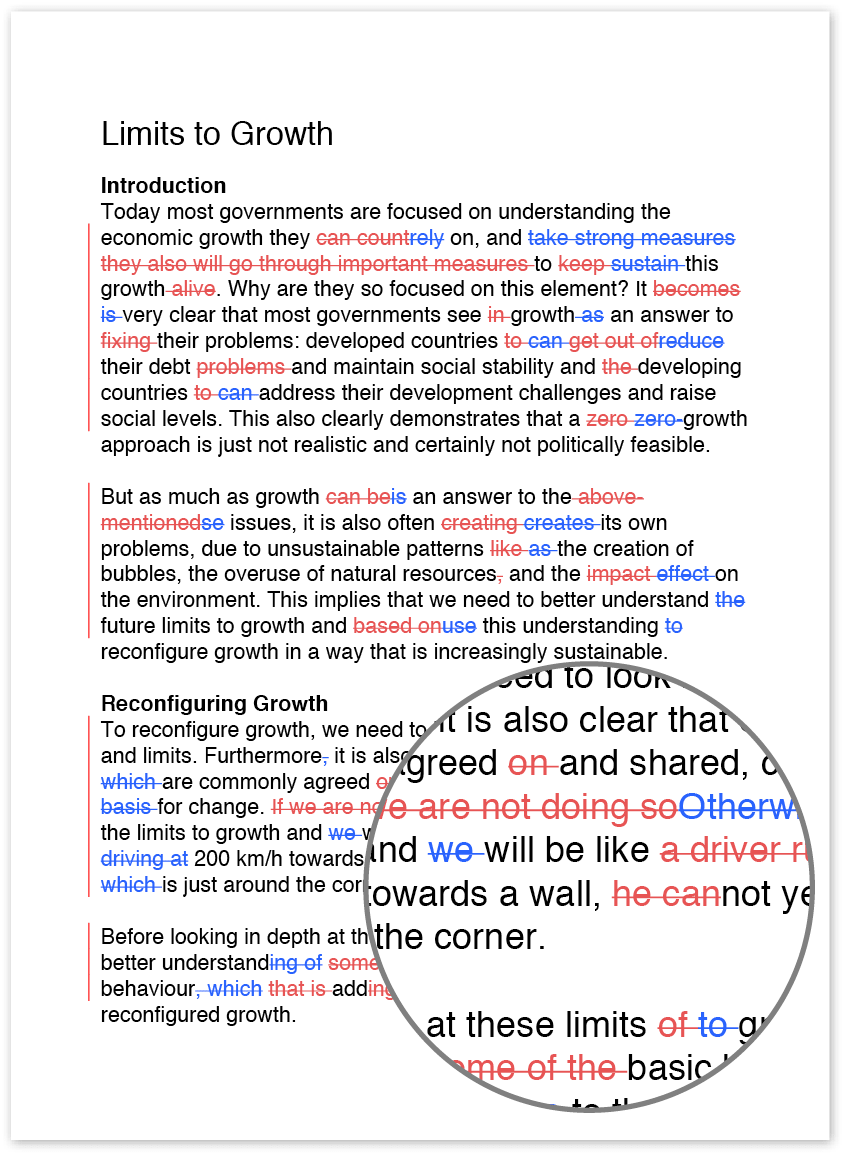
You cannot revise and edit your writing too much. Inevitably there comes a point when you have done your best and someone else must take over, but the more often you can come back to your writing with a fresh pair of eyes, the more likely it is that you will emerge with a crisp and efficient communication.
Key points
- Give yourself time and space to revisit your writing with a fresh pair of eyes
- Remember that editing your own work is difficult; pass your work over to a colleague. At the end of this process send it to the professionals. Wordy will find those infelicities that no-one else has spotted.
Self-editing
Self-editing is not easy, but it is possible, especially if you give yourself a break from a document.
- Look at structure, grammar, punctuation and meaning. Meaning may be the most difficult one to spot the holes in; after all, you know what you mean and it’s difficult to spot where other people won’t.
- Think about content – are you sure there is nothing unnecessary in there?
- Look at sentence length, even if you are sure you have the grammar correct – consider breaking a long sentence up. It isn’t universally the right thing to do, but is worth thinking about.
A fresh pair of eyes
It is a rare writer who can edit their text efficiently. In book publishing editors and proofreaders are provided to polish the text. In an office setting you can perhaps ask a colleague or team member to review what you have written, or you can employ an agency such as Wordy.
You can also try out text on your prospective audience – web designers and marketeers do this as a matter of routine. If you are a non-native speaker of English, getting a native speaker to review your work will throw up awkward phrasing and off-key use of words.
Model for best practice content writing
- Define purpose of document.
- Define target audience for document.
- Set way points for progress.
- Gather your team if more than one person is involved. You need to line up an editor, proofreader, designer, indexer, web designer and so on in good time.
- Gather key facts, and research if necessary.
- Plan your structure.
- If appropriate liaise with your designer.
- Have necessary references to hand (style guide, dictionary, web access etc).
- Start writing, making notes of any style decisions you make along the way.
- If you are not using a designer, consider the look of your document. Word styles are useful and enable you to make global changes easily.
- Take a break and revise your work, checking
- Structure – does it work?
- Content – is it all there? Can anything be omitted?
- Are grammar, punctuation and spelling correct?
- Are the words right? Does the message get over clearly?
- Send draft for consultation and approval if appropriate.
Happy best practice content writing!
Read more
Business proposals – writing, templates and formats
Effective business communication